
Africa-Asia Capital Markets / AI & Investment Intelligence, October 2026
The AI-Capital Nexus: The Fixed Cost of Unfamiliarity
How AI Could Help Credible African Transactions Reach Asian Credit Committees
AI will not eliminate the risks of investing in Africa. It could, however, make credible unfamiliar transactions cheaper to discover, faster to assess and easier to prepare for an Asian institution’s credit committee.
Dr Paul Terna Gbahabo
Director, Research & Thought Leadership, Africa-Asia
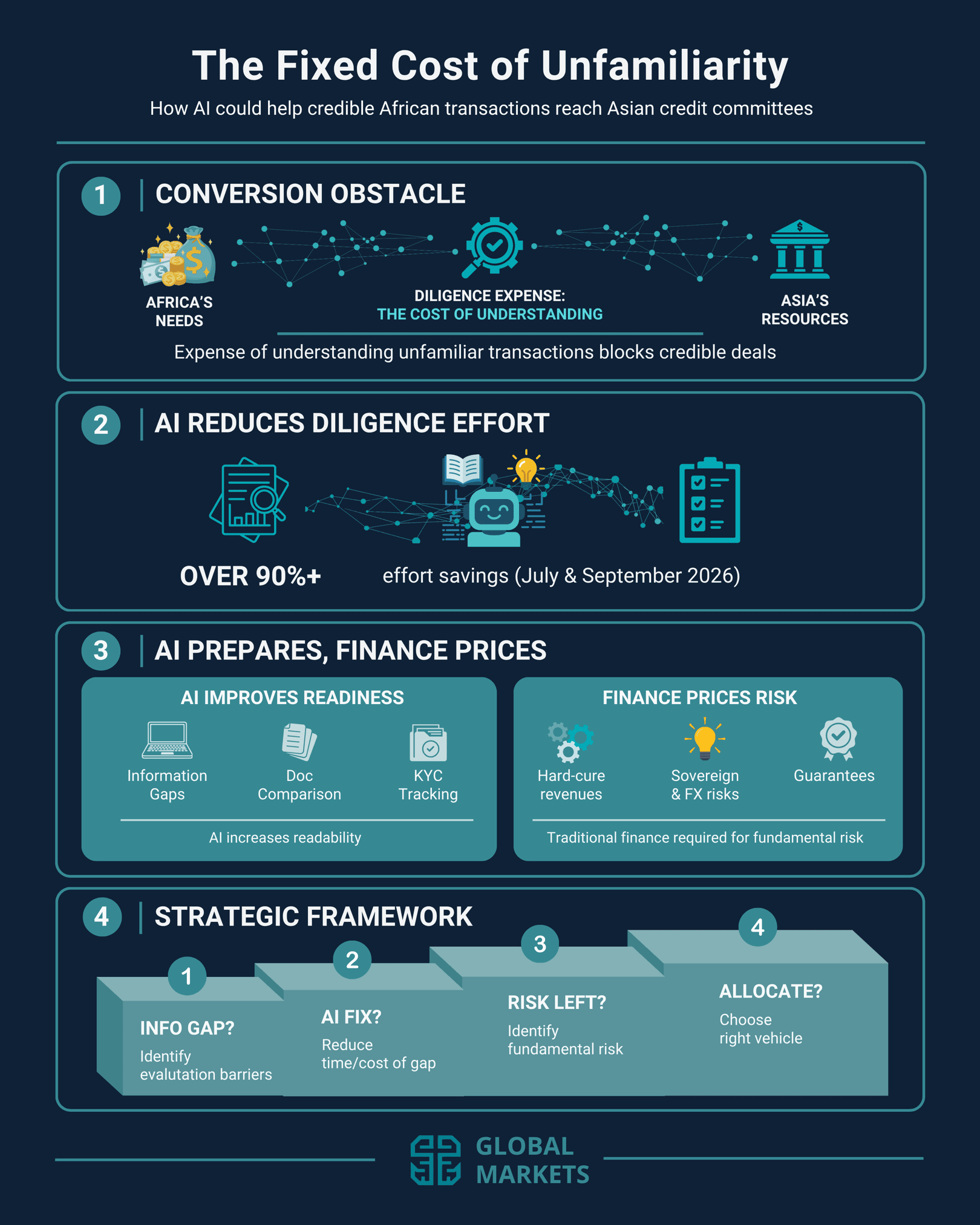
An unfamiliar African transaction carries a cost before a bank has priced a single dollar of risk: the cost of understanding it.
For an Asian institution assessing a new borrower or project, that cost can be considerable. Ownership must be established; financial statements reconciled; contracts examined; regulatory permissions understood; currency exposures mapped; KYC completed; and the transaction tested against the institution’s mandate. Much of this work happens before a lender can decide whether the opportunity merits a credit discussion.
This is the fixed cost of unfamiliarity. It can prevent an otherwise credible transaction from reaching the committee that could approve it. AI will not eliminate sovereign risk, foreign-exchange constraints or poor project economics. But it may materially reduce the time and cost of determining whether an unfamiliar opportunity deserves financing.
The fixed cost of unfamiliarity
Africa’s financing needs and Asia’s capital resources are not, by themselves, a transaction. Between them sits a demanding conversion process. A financing proposal must become a sufficiently evidenced, structured and mandate-compatible exposure. The obstacle may be credit risk; but sometimes it is the expense of establishing what the risk actually is.
That distinction matters. If a transaction is blocked by missing ownership records, inconsistent forecasts or an incomplete data room, an expensive guarantee is not the first answer. If the obstacle is an unhedgeable currency mismatch or an internal country limit, better documents alone will not solve it. The first task is to diagnose the binding constraint.
Discovery and diligence
AI-enabled tools can screen company filings, procurement records, market data and other sources against a bank’s sector, ticket-size, tenor and jurisdiction criteria. They can compare information memoranda, search lengthy contracts, flag contradictory figures and produce diligence questions linked to source documents. That can make previously unfamiliar opportunities easier to discover and reject weak propositions earlier.
The emerging evidence is promising but narrower than the most enthusiastic claims. A July 2026 Crisil Integral IQ case study describes AI-enabled automation across sourcing, company screening, diligence and portfolio monitoring for an unnamed US private-equity firm. Crisil reported more than 90% effort savings across automated manual-research workflows, not a 90% reduction at every stage.
The commercial value is not simply faster research. It is faster, more disciplined hypothesis testing: does this borrower have the cash flow, ownership transparency and contractual protection that an unfamiliar lender would require? Material findings still need source traceability, human verification and secure handling of confidential data.
Making transactions committee-ready
Diligence is useful only if it helps an institution make a decision. AI can assist originators and advisers in checking data-room completeness, comparing financial and legal documents, tracking missing KYC items, preparing first-draft investment materials and identifying the precise evidence needed for internal approval. This can turn an unstructured financing request into a more credible, reviewable proposition.
A September 2026 Crisil Integral IQ case study reports a proof of concept at an unnamed US bank that used generative AI to extract more than 100 fields from credit agreements. In testing on a sample document set, it reported 60-70% better loan-booking efficiency, 80% better data-remediation efficiency, over 50% shorter turnaround and 93% extraction accuracy. These are proof-of-concept workflow results, not evidence of a production-wide rollout or an AI-enabled African financing.
The important question is whether such capabilities can lower the cost of preparing and assessing cross-border transactions without weakening credit discipline. AI-generated summaries are not substitutes for signed agreements, audited accounts, legal opinions or accountable committee decisions.
What AI cannot solve
An excellent data room cannot create hard-currency revenues, make a fragile project profitable, remove sovereign risk, repair defective governance or override a bank’s exposure limits. Nor can AI provide a guarantee, an export-credit insurance policy, a hedge or the balance sheet required to hold a loan.
Those problems require finance to do its job: price risk, allocate it, insure or guarantee it where appropriate, redesign cash flows, adjust tenor, syndicate exposure or decline the transaction. Successful Africa-Asia precedents, including guaranteed bonds and insured lending, illustrate the importance of institutional structures; they are not evidence that AI itself closed those transactions.
AI introduces risks of its own: inaccurate extraction, invented facts, bias, confidential-data leakage and inconsistent treatment across legal jurisdictions. Source-linked outputs, expert review and clear responsibility at every material approval gate are essential.
Building an Africa-Asia intelligence layer
The strategic opportunity is not another AI dashboard. It is a trusted intelligence layer linking African origination and verification to the specific requirements of Asian banks, policy lenders, export-credit agencies and institutional investors. African intermediaries can help standardise and validate pipelines. Asian institutions can define the evidence, eligibility and risk parameters their committees actually need. Technology can keep the information current and reveal exceptions before they become late-stage surprises.
This is also why Global Markets frames the Bangkok conversation differently. The wrong question is, “Are you interested in Africa?” The useful questions are: What exposure can you hold directly? What must be transferred? What information or mitigant would change your approval decision? What would move the transaction into credit?
Where the problem is information, AI can improve intelligence. Where the problem is preparation, AI can improve readiness. But where the problem is credit, currency or risk, finance still has to do its job.
For every prospective Africa-Asia transaction, four questions should guide action:
- What information or preparation gap is preventing the institution from evaluating the opportunity?
- Can AI materially reduce the time, cost or uncertainty involved in closing that gap?
- Once the information problem is solved, what financial, regulatory or institutional risk still prevents approval?
- Which institution, instrument or structure is equipped to carry or change that remaining risk?
- #AfricaAsia
- #InvestmentIntelligence
- #CapitalMarkets
- #ArtificialIntelligence
AI cannot make a bad transaction bankable. Its more credible promise is to help a good, unfamiliar transaction reach a real capital-allocation decision.
Sources and evidence notes
Related Global Markets research
Flagship special report, September 2026
The Africa-Asia Execution Gap