
Flagship special report, September 2026
The Africa-Asia Execution Gap
Why capital is lost between opportunity and allocation, and how successful transactions redesign the gates
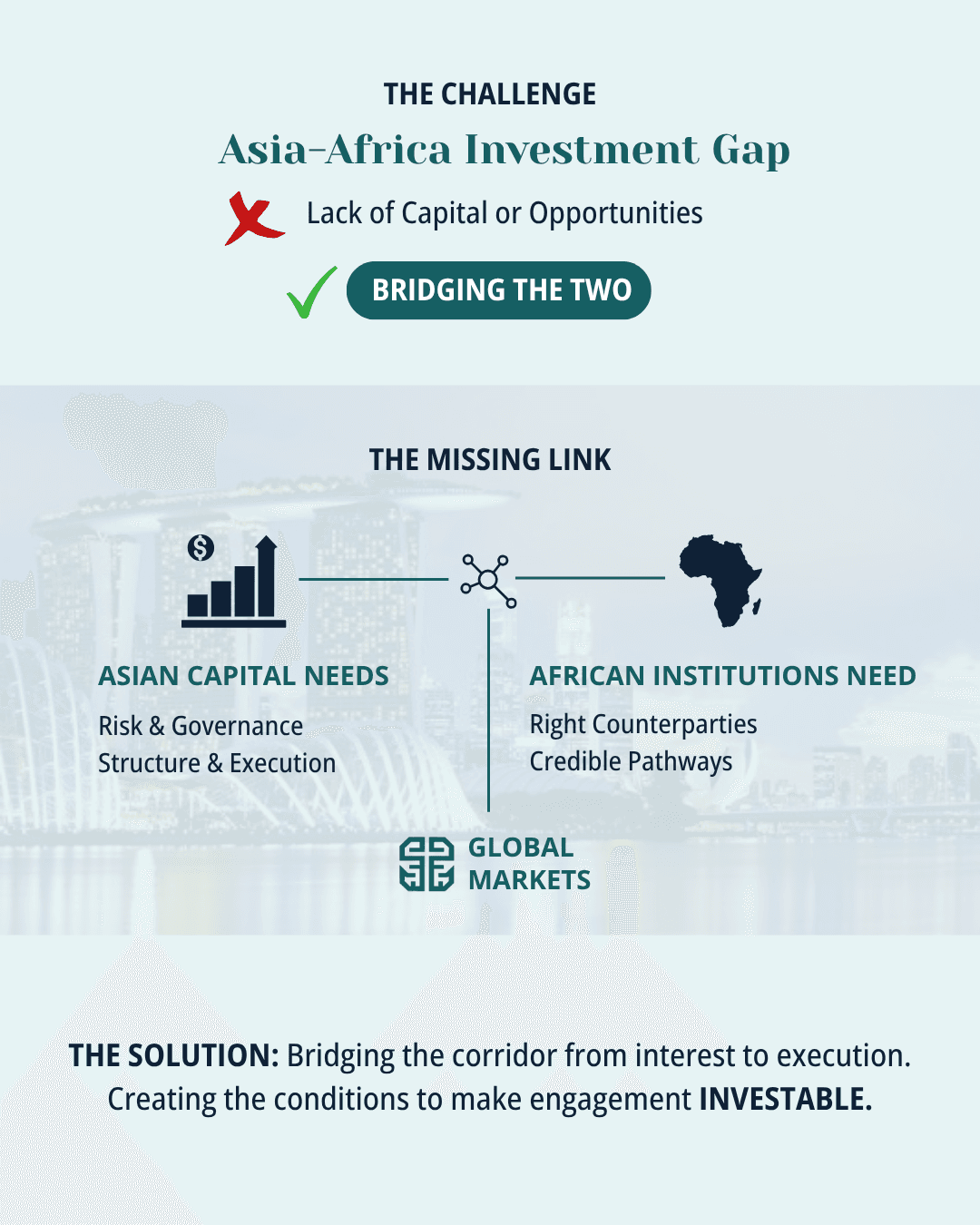
Africa does not suffer from a simple shortage of opportunities, nor Asia from a shortage of capital. The harder problem is conversion: turning an African financing need into an asset that can survive an Asian institution’s information, currency, rating, scale, mandate and approval gates. A review of 13 transactions shows that successful deals do not eliminate risk. They identify it, allocate it and leave each institution holding only the risk it is structurally equipped to bear.
Dr Paul Terna Gbahabo
Director, Research & Thought Leadership, Africa-Asia
Evidence base: IMF, World Bank, AfDB, OECD/AUC, UNCTAD, IEA, Afreximbank, ADB and transaction-level sources from AIIB, JBIC, NEXI, DBS and African institutions.
The argument in summary
The Africa-Asia capital story is often told as a search problem: Africa has bankable projects, Asia has huge, accumulated savings, and the task is to connect the two. However, the evidence points to a more complex diagnosis. The corridor has an execution problem. Capital is lost as an opportunity moves through a sequence of conversion gates; from information and project preparation, through currency and sovereign risk, to scale, market access, internal limits, and final approval.
The paradox is visible in the numbers: the IMF projects Sub-Saharan Africa to grow by 4.3% in 2026. Yet Africa captured only 6-8% of global private infrastructure investment between 2013 and 2022, while private capital accounted for about 11% of the continent’s infrastructure finance. The AUC/OECD estimates infrastructure WACC at 13% in Africa, against 10% in developing Asia and 8% in OECD economies. The before-tax cost of commercial debt is estimated at 18.6% in Africa versus 11.4% in developing Asia. These are not simply measures of scarcity; they are prices attached to risk, information, liquidity and institutional constraints.
Yet the evidence also cautions against a fatalistic “Africa risk” explanation. IMF research estimates a residual premium of about 46 basis points on sub-Saharan African sovereign issuance after controlling for fundamentals, global factors and bond characteristics; that premium rises above 120 basis points during global shocks. OECD data show a different constraint: at end-2024 only Botswana and Mauritius held investment-grade sovereign ratings, while around 80% of rated African countries were high risk or below. In other words, perceived risk may matter, but formal eligibility and mandate rules can stop capital before pricing begins.
The transaction record is more revealing than the rhetoric. Egypt’s RMB3.5bn Panda bond reached China’s interbank market only after AfDB and AIIB guarantees helped it attain the required credit profile. NEXI’s US$520m and US$207m insured facilities to Afreximbank enabled Japanese banks and investors to fund African on-lending with 100% political-risk and 90% credit-risk cover. In the Mozambique-Malawi Nacala corridor, NEXI insured US$1bn of commercial loans for 14 years, again at 100% political-risk and 90% credit-risk coverage. Mozambique LNG distributed a US$14.4bn financing stack across JBIC, other ECAs/DFIs and 21 private financial institutions. But Senegal’s US$71m FSRU financing shows the opposite: MUFG participated alongside JBIC without a disclosed NEXI wrapper, because the sponsor, asset and contractual chain narrowed the credit problem sufficiently. Afreximbank’s JPY81.3bn debut Samurai bond provides another counterexample: a strong African institutional credit can reach Japanese investors directly.
The investable proposition is not Africa needs capital. It is here is the cash flow, here are the risks, here is who holds each part of the risks, and here is why the remaining exposure fits your mandate.
This suggests a different agenda for Africa-Asia finance. The objective should not be to generate more introductions. It should be to financially engineer higher conversion rates from interest to mandates, from mandates to term sheets, and from term sheets to funded transactions. This requires treating each failed deal as a diagnostic event: at which gate did it stop, why, and which institution or structure could change the decision?
Exhibit 1
The capital paradox
- SSA real GDP growth
- 4.3%
- 2026 forecast
- Source: IMF
- Africa infrastructure WACC
- 13%
- vs 10% in developing Asia; 8% OECD
- Source: AUC/OECD
- Before-tax commercial debt cost
- 18.6%
- vs 11.4% in developing Asia
- Source: AUC/OECD
- Private share of infrastructure finance
- ~11%
- Africa
- Source: AUC/OECD
- Africa share of global private infrastructure investment
- 6-8%
- 2013-2022
- Source: AUC/OECD
- Private finance mobilised in Africa
- US$19.7bn/yr
- 2021-2024 average
- Source: OECD
Note: Figures measure different concepts and periods; they should not be summed. Together they describe the conversion problem: large needs and growth coexist with high financing costs and selective private allocation.
The streetlight effect in African project financing
Moving beyond the perceived funding gap to fix the market conversion bottleneck.
The standard framing starts with a financing gap. The African Development Bank continues to estimate annual infrastructure needs at roughly US$130-170bn, with a financing gap of about US$68-108bn. Those numbers are useful for scale, but they can encourage the wrong operating question: How can Africa overcome the financing gap?
The more useful question is why large pools of capital repeatedly fail to convert into African exposure. The answer cannot be that no private capital is being mobilised. OECD data show official development-finance interventions mobilised a record US$77bn globally in 2024. Africa was the largest beneficiary region over 2021-2024, receiving 30% of the total, or US$19.7bn a year on average. Guarantees, direct investment and syndicated lending are already moving capital. But nearly 70% of mobilised finance globally still went to middle-income non-LDC markets. Mobilisation is therefore real and highly selective.
The same selectivity appears within Africa. The AUC/OECD finds that five countries comprising Ethiopia, Egypt, Nigeria, Kenya and Côte d’Ivoire accounted for 52% of mobilised private infrastructure finance over 2013-2023. This concentration is not proof that other markets lack opportunities. It is consistent with a system that rewards bankable pipelines, institutional capacity, market size, documentation and structures that allow investors to quantify and distribute risk.
The FDI numbers tell a similar story. UNCTAD recorded US$97bn of FDI inflows to Africa in 2024, but an exceptional transaction in Egypt heavily skewed the headline figure. Excluding that effect, inflows were about US$62bn, up roughly 12%, but Africa’s share of global FDI remained around 4%. Meanwhile, announced greenfield investment fell 37% to US$113bn even as international project-finance deal value rose 15% to US$99bn. The lesson is not that investment is absent; it is that the route by which capital is structured matters as much as the volume of interest.
The corridor already exists.
The Asian corridor remains a vital fixture in Africa’s financing landscape. Evidence from successful deals shows that Asian capital represents the patient, long-term commitment required for African project finance. UNCTAD data put China’s FDI stock in Africa at about US$44bn in 2023, Singapore’s at US$24bn, and India’s at US$13bn. China-Africa goods trade reached US$314.4bn in the first eleven months of 2025. Japan’s TICAD9 commitments included a JICA overseas investment and finance mobilisation target of US$1.5bn. The relevant problem statement is therefore not to prove that an Africa-Asia corridor exists. It is to improve the institutional machinery that converts commercial relationships into financeable assets.
The seven conversion gates
A transaction rarely dies for one reason. It moves through a chain of institutional tests. The order varies by instrument, but the evidence points to seven recurring gates. A project that clears six and fails one still receives no capital.
Gate 1Information must become decision-grade
Investors do not allocate to “opportunity”; they allocate information they can underwrite. The gap is often not the absence of data but the absence of verified, comparable, decision-grade material: sponsor history, financial model, permits, contracts, demand assumptions, legal opinions, environmental and social documentation, monitoring architecture, and a data room that can withstand diligence. ADB’s US$78m Asia Pacific Project Preparation Facility is instructive precisely because it treats technical, financial, economic, legal, regulatory, governance and safeguards preparation as part of financing infrastructure, not an administrative prelude.
For an unfamiliar African exposure, poor preparation raises the fixed cost of origination. The rational response of an Asian bank is often not to charge a higher spread but to stop spending scarce credit-team time. That distinction matters. Better marketing does not solve a diligence problem.
Gate 2Currency risks must be allocated, not merely priced
Foreign currency can make funding look cheaper at signing but more expensive over the asset’s life. OECD analysis finds that in 2024 foreign-currency carry costs exceeded local-currency debt costs in 13 out of 16 African countries with comparable data. The right question is not “Is FX risk high?” but which component is binding: volatility, convertibility, transferability, hedge availability, hedge tenor, or hedge cost.
Export earners can naturally hedge hard-currency debt; domestic utilities and infrastructure assets often cannot. CFA-zone borrowers face a different euro-risk profile than those in the anglophone corridor, such as Nigeria or Ghana. The structuring task is to place currency risk with the party best able to bear it, through local-currency funding, indexation, swaps, blended hedging facilities, convertibility cover, or hard-currency revenue, rather than leave it as an unpriced residual.
Gate 3Credit quality must fit the mandate
A compelling yield cannot compensate for an asset that an institution is prohibited from holding. At end-2024, OECD data show only Botswana and Mauritius with investment-grade sovereign ratings and roughly 80% of rated African sovereigns in high-risk or lower categories. Rating floors, country limits and concentration rules can therefore make an exposure ineligible before a portfolio manager considers return.
This is where the language of a generic “Africa premium” becomes misleading. IMF research estimates a residual SSA sovereign issuance premium of about 46bp after controlling for issuer fundamentals, global factors and bond characteristics, rising above 120bp during global shocks. The result does not imply that African sovereign risk is trivial. It implies that fundamentals, liquidity, global conditions and formal risk rules need to be separated before prescribing a solution.
Gate 4The asset must be large enough to matter
Institutional capital has a minimum efficient ticket. Origination, legal work, diligence, and monitoring have fixed costs; a US$20m bespoke project can be economically sound and still inefficient for a large bank, insurer, or asset manager. OECD notes that common emerging-market sovereign indices often use minimum issue sizes around US$500m, alongside liquidity and accessibility requirements. Africa accounts for roughly 1% of global sovereign bonds despite about 3% of global GDP, and only about 25% of African government debt is marketable, the lowest regional share in the OECD comparison.
The practical response is aggregation: pooled vehicles, DFI intermediation, portfolio guarantees, warehouse structures, benchmark issuance and reopenings. The financing product must sometimes be redesigned before the underlying assets become institutionally efficient.
Gate 5Market plumbing must permit entry and exit
Creditworthiness is necessary but not sufficient. Foreign investors need predictable rules for custody, settlement, taxation, repatriation, convertibility and, for mark-to-market investors, exit. A local-currency instrument can remove borrower FX mismatch while creating investor concerns about hedging and repatriation. A hard-currency bond can solve settlement and liquidity while transferring FX risk back to the issuer. Instrument choice is therefore a deliberate allocation of risk, not a superficial currency decision.
Gate 6The exposure must survive internal capital economics.
A relationship manager’s enthusiasm is not an approval. Commercial banks must run transactions through credit committees, country ceilings, regulatory capital, concentration limits, and return-on-capital tests. This is why guarantees and risk-sharing facilities matter even when the underlying borrower has not changed. IFC and DBS’s US$500m Global Trade Liquidity Programme facility shares risk equally on emerging-market trade assets, explicitly expanding DBS’s capacity to finance trade while managing risk. The mechanism, not the geography, changes what the balance sheet can hold.
Gate 7Execution needs a trusted institutional pathway
The final gate is relational but not soft. Repeatable co-financing channels reduce origination costs, establish documentation norms and create counterparties that investment committees already know. African DFIs can aggregate smaller assets, originate pipelines, provide local information and become the borrower or gateway through which Asian institutions take exposure. Japanese financing repeatedly shows the pattern: commercial banks sit beside JBIC or NEXI; African DFIs sit between Asian balance sheets and dispersed African uses; sponsors and offtakers complete the contractual chain.
Exhibit 2
The seven-conversion gates
Gate: 1. Information
- Decision question
- Can the opportunity survive diligence?
- Typical conversion lever
- Verified data room; preparation facility; trusted originator
Gate: 2. Currency
- Decision question
- Who can bear FX/convertibility risk?
- Typical conversion lever
- Local currency; hedge; indexed revenues; cover
Gate: 3. Eligibility
- Decision question
- Does rating/country risk fit the mandate?
- Typical conversion lever
- Guarantee; seniority; risk sharing; stronger counterparty
Gate: 4. Scale
- Decision question
- Is the ticket efficient to originate and monitor?
- Typical conversion lever
- Aggregation; pooled vehicle; benchmark issue
Gate: 5. Market access
- Decision question
- Can capital enter, settle, hedge and exit?
- Typical conversion lever
- Market plumbing; repatriation clarity; liquidity
Gate: 6. Internal approval
- Decision question
- Does the exposure fit capital and limits?
- Typical conversion lever
- Distribution; insurance; shorter tenor; capital relief
Gate: 7. Execution pathway
- Decision question
- Who can originate and coordinate repeatedly?
- Typical conversion lever
- DFI gateway; ECA/policy-bank stack; co-financing platform
Note: The framework is diagnostic, not sequential in every transaction. The binding gate differs by institution, country and instrument.
Follow the money: what successful transactions reveal
Risk appetite is better inferred from funded transactions than from conference statements. Thirteen Africa-Asia cases in the Global Markets Africa financing database show five recurring patterns: risk transfer precedes scale; policy institutions are catalytic; contractual cash flows can substitute for broad sovereign comfort; relationship history reduces execution friction; and private capital still retains residual risk. The cases also show an important counterpoint: public de-risking is not always necessary when the underlying credit is already institutionally acceptable.
China: Egypt’s Panda bond turned market access into a structuring problem
In October 2023, Egypt issued a three-year RMB3.5bn sustainable Panda bond, the first African sovereign bond in China’s interbank bond market. AfDB and AIIB supplied partial guarantees. AIIB approved up to US$200m equivalent in CNY and stated explicitly that the bond needed a partial debt guarantee to reach an investment-grade rating under the Panda-market structure; AfDB approved up to US$345m equivalent. Bank of China led the underwriting, with support from HSBC China.
The significance is not that Chinese investors suddenly became comfortable with undifferentiated Egyptian sovereign risk. The credit architecture changed the asset they were being asked to buy. AAA MDB guarantees altered the rating profile, while Egypt’s sustainable-financing framework specified eligible uses of proceeds. Investors still retained residual sovereign, market and liquidity risk outside the guaranteed perimeter. The transaction therefore demonstrates a conversion mechanism: market access + domestic issuance rules + credit enhancement + a credible use-of-proceeds framework.
Japan: NEXI shows how risk can be carved out of the private balance sheet
The clearest revealed-preference evidence comes from NEXI. In 2020, it insured a US$520m, 10-year Overseas Untied Loan to Afreximbank funded by MUFG Bank, Mitsubishi UFJ Trust, and a wider group of Japanese banks, life insurers, and investors. NEXI covered 100% political risk and 90% of credit risk. In 2022, the architecture was repeated for a US$207m, 10-year healthcare facility funded by MUFG Bank and Mitsubishi UFJ Trust, again with 100% political and 90% credit-risk cover.
Two lessons follow. First, Japanese procurement is not universally required for NEXI-supported African DFI lending: both were untied structures. Second, insurance did not eliminate private risk. The lenders retained the uncovered credit portion and risks outside policy terms, including documentation and claims-process risk. The structure succeeded because it narrowed the exposure to a residual that the private institutions could accept, while the African DFI provided a scalable, familiar counterparty and on-lending gateway.
Infrastructure: the financing stack can be more important than the headline borrower
The Mozambique-Malawi Nacala rail and port project is an unusually transparent example. Commercial co-financing totalled about US$2.7bn. NEXI insured US$1bn worth of loans from six banks and institutional lenders for 14 years, covering 100% of political risk and 90% of commercial risk; JBIC, AfDB and South Africa’s ECIC also participated. The project combined Japanese sponsor involvement and resource-security logic with a multi-institutional risk stack. Private lenders were not asked to hold the full project and country risk package.
Mozambique LNG took the principle to a much larger scale. JBIC committed up to US$3bn within a US$14.4bn project-finance package that included AfDB, US EXIM, UKEF, Exim Thailand and 21 private financial institutions, with portions of private lending insured or guaranteed by NEXI, UKEF and SACE. The architecture distributed risk across institutions with different mandates rather than forcing one balance sheet to solve every problem.
Contracts can sometimes do what insurance does.
Senegal’s FSRU financing is a useful counterexample. JBIC provided up to about US$35m, and MUFG co-financed a total facility of about US$71m to a project company backed by Mitsui O.S.K. Lines, with no explicit identification of any NEXI cover. The asset had a specific operating role in an LNG-to-power chain, with electricity ultimately sold to state-owned Senelec. MUFG therefore appears to have retained meaningful project-finance exposure alongside JBIC. The lesson is not that the deal was low risk; it is that sponsor quality, a tangible asset, contracted commercial relationships, and policy-bank participation can narrow the risk sufficiently without comprehensive insurance.
Egypt’s Gulf of Suez wind financings show the complementary case. For the 500MW Red Sea Wind project, JBIC provided up to about US$240m within roughly US$501m of co-financing, alongside EBRD and private banks. Electricity is sold under a 25-year PPA. In the 2024 expansion, NEXI insured approximately US$35m of commercial-bank lending for 21 years with 100% political-risk and 97.5% commercial-risk cover; Egypt’s Ministry of Finance guaranteed the PPA. Here, contract quality, sovereign-backed offtake, policy-bank lending and ECA insurance reinforce one another.
Strong credits can bypass the wrapper.
Afreximbank’s 2024 Samurai bond prevents the evidence from becoming a simplistic argument for guarantees. The bank raised JPY81.3bn, about US$530m, across regular and retail Samurai tranches, attracting close to 150 institutional orders excluding retail and extending maturities to ten years. No ECA or MDB guarantee was identified. Japanese investors were willing to hold Afreximbank credit directly, supported by its rating, market documentation, investor education and repeatable institutional profile.
That matters because de-risking should be targeted, not automatic. Public guarantees are scarce balance-sheet resources. Where the borrower or asset already meets investor requirements, the better intervention may be rating work, disclosure, distribution, market access or relationship development rather than risk transfer.
Exhibit 3
Transaction evidence: how the gate was passed
Transaction: Egypt Panda bond
- Scale/tenor
- RMB3.5bn
- Key structure
- AfDB + AIIB partial guarantees
- Gate changed
- Rating / Chinese market access
Transaction: Afreximbank Samurai
- Scale/tenor
- JPY81.3bn
- Key structure
- No public guarantee identified
- Gate changed
- Standalone credit/distribution
Transaction: Afreximbank-NEXI 2020
- Scale/tenor
- US$520m; 10y
- Key structure
- 100% political; 90% credit cover
- Gate changed
- DFI gateway/risk transfer
Transaction: Afreximbank-NEXI 2022
- Scale/tenor
- US$207m; 10y
- Key structure
- 100% political; 90% credit cover
- Gate changed
- Untied DFI lending
Transaction: Nacala rail/port
- Scale/tenor
- US$1bn NEXI-insured; 14y
- Key structure
- 100% political; 90% commercial
- Gate changed
- Long-tenor infrastructure
Transaction: Mozambique LNG
- Scale/tenor
- US$14.4bn total
- Key structure
- JBIC + ECAs/DFIs + 21 private FIs
- Gate changed
- Distributed financing stack
Transaction: Senegal FSRU
- Scale/tenor
- US$71m total
- Key structure
- JBIC co-lending; no NEXI identified
- Gate changed
- Sponsor/contracts / co-lender
Transaction: Egypt wind expansion
- Scale/tenor
- ~US$35m insured; 21y
- Key structure
- 100% political; 97.5% commercial + PPA guarantee
- Gate changed
- Offtake/tenor / ECA cover
Transaction: Kenya Samurai loan
- Scale/tenor
- Up to JPY25bn
- Key structure
- NEXI insurance; 8 Japanese banks
- Gate changed
- Relationship pathway / sovereign facility
Note: Amounts refer to the relevant transaction or insured portion as indicated. Several public sources do not disclose pricing, full hedge arrangements or precise residual risk; those terms should not be inferred.
The Asian capital landscape is a complex mosaic, far from a single monolith
The execution-gap framework only works if institutions are differentiated. A commercial bank, policy bank, export-credit insurer, MDB and long-duration asset owner do not solve the same problem. They should not receive the same pitch.
Commercial banks such as DBS, MUFG, Mizuho, and ICBC allocate balance sheet capacity against borrower credit, country limits, capital consumption, tenor, security, client relevance, and return. Their capacity can expand when another institution shares risk, as the IFC-DBS trade facility demonstrates. Japanese megabanks can also participate inside JBIC/NEXI structures where project contracts and public risk mitigation reduce the residual exposure.
JBIC is a policy bank, not simply a cheaper commercial lender. Its transactions repeatedly connect Japanese strategic or economic interests with overseas investment and project finance. NEXI is an insurer, not a lender: its value is to change the risk that commercial lenders or investors must retain. AIIB and ADB combine credit analysis with development impact, eligibility, safeguards and mobilisation objectives. Institutional investors, including pensions, insurers, asset managers and sovereign funds, typically require assets that fit rating, duration, liquidity and portfolio constraints; they are more likely to buy a scalable instrument or vehicle than to diligence a fragmented list of projects.
The implication is operational. An African principal should not ask, “Are you interested in Africa?” The better sequence is: What instrument can you provide? What risk can you hold? What risk must someone else hold? Where does approval fail? What structure, information or counterparty would change that decision?
Exhibit 4
Different capital, different approval logic
Institution type: Commercial bank
- What it can provide
- Loans, project/trade finance, arranging
- Approval logic
- Credit, country limits, capital use, client economics
- What makes the proposition investable
- Strong cash flow; acceptable residual risk; distribution/cover where needed
Institution type: Policy bank (JBIC)
- What it can provide
- Project, investment, export/strategic finance
- Approval logic
- Policy mandate + bankability + Japanese nexus
- What makes the proposition investable
- Strategic fit; credible sponsor/project; co-financing architecture
Institution type: ECA (NEXI)
- What it can provide
- Political/commercial risk insurance
- Approval logic
- Eligibility + policy purpose + insurable risk
- What makes the proposition investable
- Defined covered risk; compliant structure; private capital to insure
Institution type: MDB (AIIB/ADB/AfDB)
- What it can provide
- Loans, guarantees, co-financing
- Approval logic
- Credit + development impact + safeguards + additionality
- What makes the proposition investable
- Eligible project; preparation; safeguards; mobilisation potential
Institution type: Institutional investor
- What it can provide
- Bonds, funds, private credit, portfolios
- Approval logic
- Rating, duration, liquidity, return, mandate
- What makes the proposition investable
- Scale; standardisation; disclosure; investable instrument
Note: Ticket sizes and internal country limits are generally transaction-specific and often not public. The table describes institutional logic, not universal thresholds.
How to redesign the gates
The practical response is not a single new fund. It is a conversion architecture that identifies the binding constraint at each gate early and assigns it to the institution best equipped to change it. Five design principles follow from the evidence.
First, diagnose before de-risking. A guarantee is wasteful if the real problem is an incomplete data room, an uneconomic hedge or a ticket too small to justify due diligence. Each opportunity should begin with a conversion audit: information, FX, credit/rating, scale, market access, internal capital and execution pathway.
Second, design the residual risk deliberately. The goal is not a “risk-free” transaction. NEXI’s 90% commercial/credit-risk structures are revealing precisely because private lenders still retain a slice of risk. The structuring question is what each institution is willing to retain after mitigation, and whether that residual is large enough to preserve discipline but small enough to pass approval.
Third, build institution stacks rather than single lender asks. A realistic West African structure may combine an African borrower or DFI, an Asian commercial bank, an ECA or policy bank, an MDB guarantee, a sponsor/offtaker and a hedge provider. Mozambique LNG and Nacala are large examples; the same logic applies at the portfolio level for smaller trade, infrastructure, or SME assets.
Fourth, aggregate before distribution. If Asian institutions cannot efficiently originate dozens of small exposures, African banks and DFIs can warehouse, standardise and pool them. This converts local origination capability into an institutional asset. The African institution becomes more than a recipient of capital; it becomes part of the market infrastructure.
Fifth, treat relationships as a production system. Kenya’s 2026 yen-denominated facility followed a NEXI-Kenya MOU in 2024 and a Statement of Intent in 2025 before eight Japanese banks entered the transaction. Relationship infrastructure is not evidence of a deal by itself, but it can reduce the cost and uncertainty of moving a deal through repeated institutional gates.
The scarce resource is not the first meeting. It is the institutional pathway that turns a first meeting into an approved exposure.
Where the framework matters most
The execution gap is likely to be most consequential where Africa’s financing need is large, revenues are long-dated or local-currency, and Asian institutions have relevant technology, corporate, or policy interests. Energy, transport and logistics, trade finance, digital infrastructure and manufacturing therefore deserve particular attention.
Energy illustrates the mismatch. Around 600m Africans remain without electricity, while Africa receives only about 2% of global clean-energy investment. The problem is not simply finding renewable projects. Many power assets have domestic-currency revenues, utility/offtaker risk and long payback periods. Egypt’s wind financings show the ingredients that can change that equation: a long-term PPA, sovereign support for the offtaker obligation, DFI/policy-bank participation and ECA cover. Other markets may require different combinations, but the principle is transferable.
Trade finance requires different architecture. Afreximbank estimates an annual African trade-finance gap of roughly US$100bn. The IFC-DBS facility demonstrates how portfolio risk sharing can expand an Asian bank’s emerging-market trade limits without requiring a bespoke project-finance structure for every underlying transaction. For SMEs, which Afreximbank reports constitute 80-90% of African businesses, aggregation and bank intermediation may be more relevant than direct institutional allocation.
Digital infrastructure adds another dimension. Mobile technologies contributed about US$240bn, or 7.8% of African GDP, in 2025, while operators are expected to invest more than US$76bn in network capex over 2024-2030. The opportunity is commercially material, but financing structures will need to distinguish hard-currency equipment costs from local-currency revenues, platform or operator credit, data-centre power contracts and the scale required by infrastructure investors.
The strategic implication: build a conversion layer
If the diagnosis is correct, the highest-value intermediary in the Africa-Asia corridor is not the one with the longest contact list. It is the one that can identify where a credible opportunity will fail before it reaches the wrong institution, then assemble the evidence, counterparties and risk architecture needed to move it forward.
That gap is where Global Markets operates. We work across the Africa-Asia corridor to bring institutions together, identify viable opportunities and help build the relationships and financing pathways needed to move from interest to execution. The firm’s research and convening operate as a conversion layer between African origination and Asian approval systems: classify opportunities by financing problem; route them to institutions with the relevant mandate; identify missing decision-grade information; test currency and residual-risk economics; assemble DFI/ECA/policy-bank stacks where required; and use targeted bilaterals to answer specific approval questions rather than stage generic expressions of interest.
The distinction matters for credibility. Global Markets does not claim that it can make every African project investable or that Asian capital is waiting to be unlocked. Its value proposition is narrower and more defensible: reduce avoidable execution friction, improve institutional matching, and increase the probability that credible opportunities reach the right decision process in an approvable form.
A measurable operating model
This can be tracked. Instead of counting introductions, measure conversion: opportunities screened; binding conversion gates identified; decision-grade data rooms completed; institutions matched by mandate; risk-sharing structures proposed; mandates secured; term sheets issued; and transactions funded. Over time, a proprietary database of where transactions fail by institution, instrument, country, and risk type could become more valuable than a conventional deal pipeline because it would reveal what actually changes allocation decisions.
Exhibit 5
From opportunity to allocation
Stage: 1. Originate
- Core question
- Is there a credible financing need and economic use?
- Output
- Qualified opportunity
Stage: 2. Diagnose
- Core question
- Which conversion gate is binding?
- Output
- Gate map + missing evidence
Stage: 3. Match
- Core question
- Which institution can solve that gate?
- Output
- Counterparty/institution stack
Stage: 4. Structure
- Core question
- What risk must be retained, transferred or hedged?
- Output
- Bankable architecture
Stage: 5. Validate
- Core question
- What would move the credit/investment committee?
- Output
- Decision-grade package
Stage: 6. Convert
- Core question
- Can the parties reach mandates, term sheet and funding?
- Output
- Transaction
Note: The model is intentionally institution specific. A project can move backwards as new diligence reveals a different binding constraint.
Conclusion: the next frontier is conversion efficiency
Africa’s financing debate has spent years quantifying the gap between investment needs and available capital. That gap is real. But it is too aggregate to explain why one transaction closes and another, with apparently similar economics, does not. The transaction evidence points to a more useful unit of analysis: the conversion gate.
A credible African opportunity becomes investable only after it has been translated into the language of the institution expected to fund it. For one bank, the binding issue may be country limits. For another, hedge tenor. For an insurer, eligibility. For an MDB, safeguards and additionality. For pension funds, rating, duration and liquidity. Successful deals work because the architecture changes the exposure, through information, contracts, aggregation, guarantees, insurance, co-financing, policy alignment, or trusted intermediation, until the residual risk fits an institution’s mandate.
That is why the Africa-Asia opportunity should not be framed simply as a larger flow of capital from East to West. The more consequential opportunity is to build better conversion machinery between the two. The corridor will deepen not when every Asian institution becomes more willing to take “Africa risk”, but when more African propositions reach the right institution with the right structure, evidence, and risk allocation.
- #AfricaAsia
- #CrossBorderInvestment
- #CapitalMarkets
- #TradeFinance
- #Infrastructure
The next phase of Africa-Asia finance is not about proving that capital and opportunity exist. It is about engineering the conditions under which they can transact.
Methodology and evidence discipline
This feature is based on the evidence matrix and a 13-transaction database assembled for Global Markets. Prioritised primary evidence includes IMF, World Bank, AfDB, OECD/AUC, UNCTAD, IEA, Afreximbank and ADB for market-level evidence; AIIB, JBIC, NEXI, DBS and transaction counterparties for deal terms. Transaction facts are treated as verified only where public institutional sources disclose them. Pricing, hedge structures, country limits, insurance percentages or residual risks that are not public are not inferred.
The framework is analytical rather than causal. It does not estimate the share of Africa’s financing gap attributable to each conversion gate, nor does it claim that all Asian institutions apply identical thresholds. Asian capital is explicitly disaggregated by institutional type. The transaction database is a revealed-preference sample designed to identify structuring mechanisms, not a statistically representative sample of all Africa-Asia finance.
Selected primary sources
- IMF
- Regional Economic Outlook for Sub-Saharan Africa, April 2026; WP/25/139, Navigating the Evolving Landscape of External Financing in Sub-Saharan Africa.
- AUC/OECD
- Africa’s Development Dynamics 2025; Africa Capital Markets Report 2025; Private Finance Mobilisation Report 2026.
- UNCTAD
- World Investment Report 2025, Africa regional highlights.
- AfDB
- 2024 Annual Meetings keynote; Egypt Panda Bond guarantee releases; 2026 Annual Meetings opening address.
- AIIB
- Egypt Sustainable Transport and Digital Infrastructure Guarantee; Egypt Panda Bond transaction materials.
- NEXI
- Afreximbank facilities (2020, 2022); Nacala rail/port; Gulf of Suez wind; Kenya Samurai financing.
- JBIC
- Mozambique LNG; Senegal FSRU; Egypt Red Sea Wind project finance.
- DBS / IFC
- US$500m Global Trade Liquidity Programme facility.
- Afreximbank
- African Trade Report 2025; 2024 Samurai bond transaction.
- IEA / GSMA
- World Energy Investment 2025, Africa; Mobile Economy Africa 2026.
This report is for research and discussion purposes only. It is not investment, legal, tax or credit advice. All transaction terms are based on public sources available as of September 2026; undisclosed terms remain subject to validation.
Download the report (PDF), 11 pages, opens in a new tab